
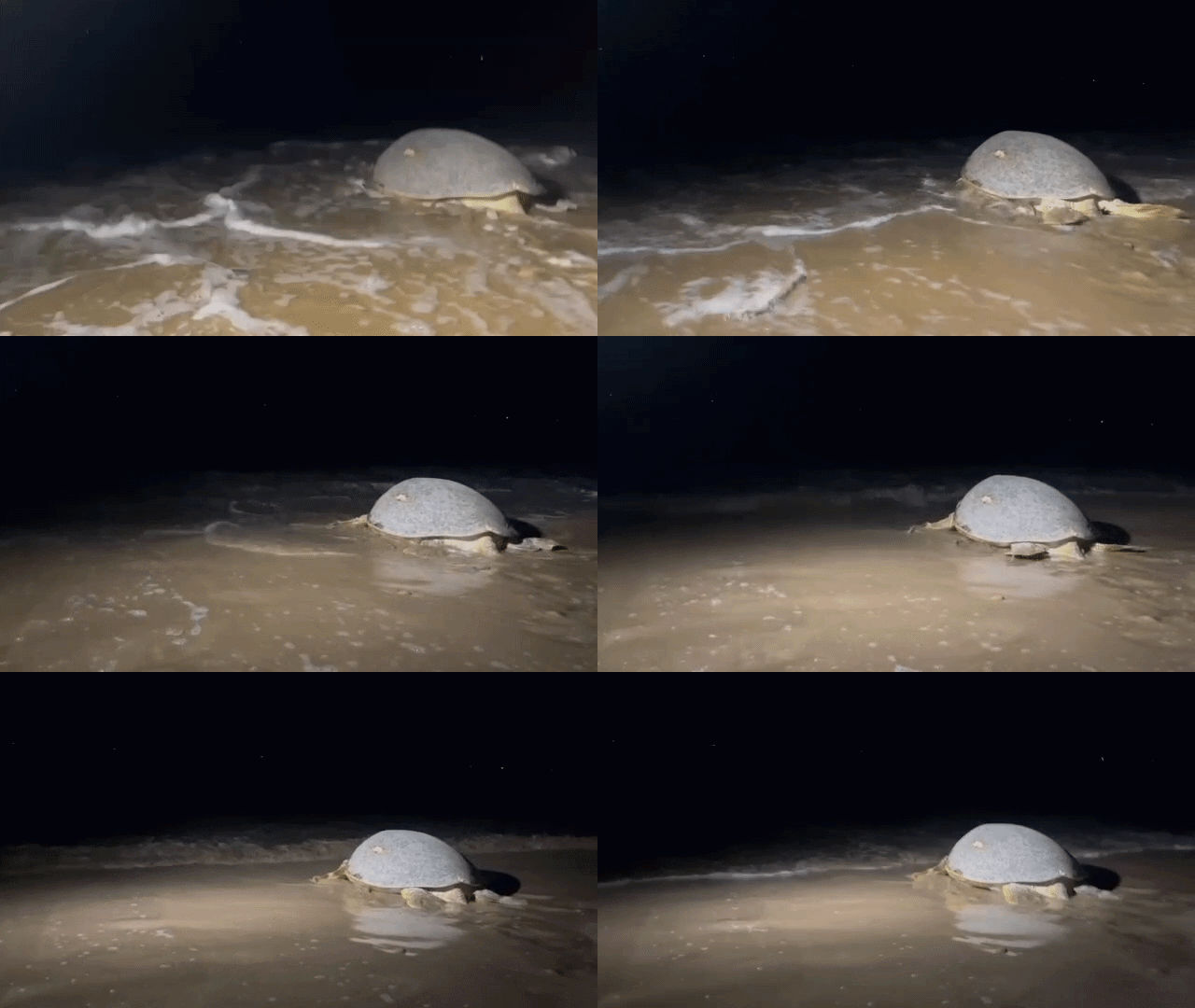
Empty Beaches: The Threats Pushing Green Sea Turtles away from Pakistan
In Pakistan, Green Sea turtles struggle to survive a world of old and new threats
Empty Beaches: The Threats Pushing Green Sea Turtles away from Pakistan
In Pakistan, Green Sea turtles struggle to survive a world of old and new threats
On a single day in April , three dead sea turtles washed up at Gwadar’s West Bay. A loggerhead, a green turtle and an olive ridley – three of the five species recorded in this country, one morning, one stretch of sand.
To understand how unlikely that morning was, consider the loggerhead. It has been sighted 12 times in Pakistan in the last 40 years.
Over the next few weeks, six more dead turtles came ashore – five at Gwadar West Bay, one at Pasni, two of them sub-adults. Some deaths were attributed to entanglement in fishing gear. The rest are a question mark, and will likely stay one.
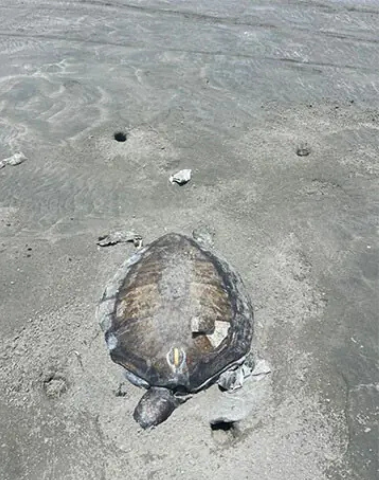
Dead sea turtle washed up on Balochistan Coastline covered in oil – Balochistan Wildlife Department
Abdul Rahim, deputy director at Gwadar Development Authority (GDA) said, “Unfortunately, we don’t have the facilities (in Balochistan) to investigate their deaths.”
However, Rahim offered two theories – the conflict in the Strait of Hormuz, and the growing use of harmful nets – and then added an important caveat: “all these theories need scientific investigation.”
So what do we actually know?
A single event of dead turtles may not seem like much, but if you widen your lens to view the whole coastline of Pakistan at once, a pattern will emerge.
A war spilling oil and stalled ships into the water. Bycatch and plastic that need no war to kill. A dredging boom clouding the water turtles feed in. Beaches so built-over that turtles struggle to return to the ones where they were born to nest.
Alone, none of it looks fatal. Together, it is how a species vanishes from a coast without ever going extinct — which is exactly what has already happened here to one species, the olive ridley.
A war at the mouth of the Gulf
Marine turtles are highly migratory. They mate in one place, forage in another, nest in a third and they cover the large distances in between. The Strait of Hormuz is not far from Balochistan’s coast. Whatever has been happening in that channel during the US-Iran confrontation has been happening in water these animals swim through.
What has been happening, among other things, is oil spills.
On June 22, a heavy layer of crude washed onto a 20-kilometre stretch of Gwadar’s west coast. Officials and experts said it was likely the result of oil tankers damaged during strikes in and around the strait.
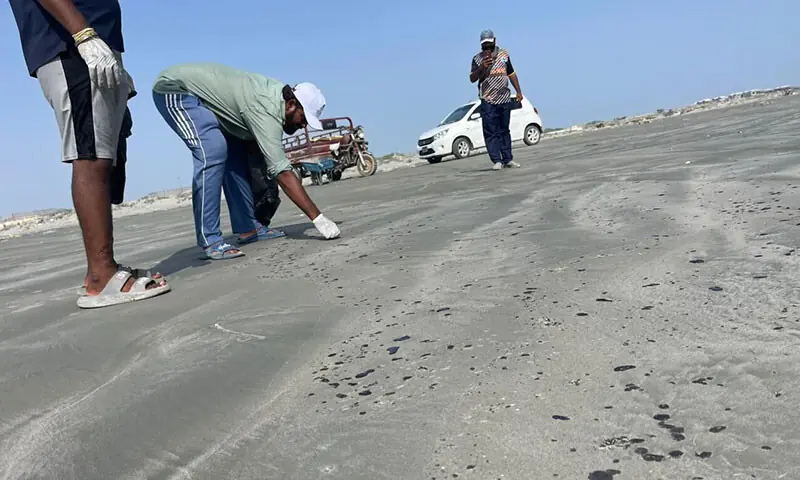
Investigators standing alongside Balochistan, Pakistan coastline, collecting samples of the crude oil – Balochistan Wildlife Department
Rahim, speaking to Citizinery, listed three possible sources: oil spilled on an Arabian Sea shipping route connected to the Hormuz, a tanker hit while trying to cross, or the bombing of Iran’s Kharg Island.
“It is highly likely that strong winds from the west, coupled with sea currents, pushed the spilled oil toward the Makran coast,” he said, adding that the presence of crude oil in intertidal zones poses a grave ecological hazard.
“This oil is extremely harmful to marine life and acts as a poison for the marine ecosystem,” he warned.
Standing on the coastline laden with black slicks of oil, Muhammad Asghar, a senior official in Balochistan’s Environment Department, who is investigating the issue, said that they were not ruling out links to the Hormuz hostilities nor to the informal oil trade with Iran.
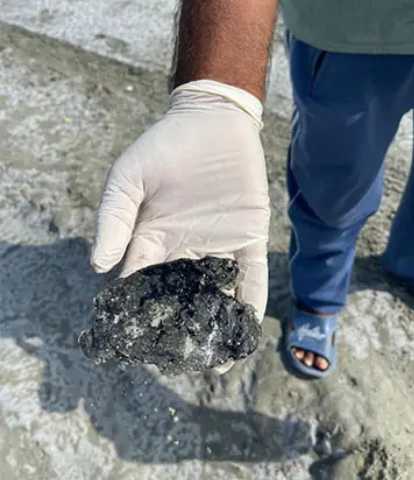
Oil samples found on Balochistan coastline – Balochistan Wildlife Department
Samples of water and sand were collected for carbon monitoring and remote sensing. The International Maritime Organization said it was aware of the reports but could not confirm the source.
Ecologist Rafi-ul-Haq called it a “transboundary ecological crisis” and warned it could raise marine mortality, particularly among turtle hatchlings. He had watched something similar during the 1990 Gulf War.
Is an oil spill really capable of doing lasting damage to a turtle population? Pakistan already ran that experiment.
In 2003 the Tasman Spirit broke up off Karachi, Pakistan’s coastal city.
“The incident had a devastating impact on marine biodiversity,” said Dr Babar Hussain, natural resource management coordinator at IUCN Pakistan.
“Since the spill, no [living] olive ridley turtles have been sighted along our shores.”
Ships that sit still
The war has produced a second threat to the turtles along this coastline, and it doesn’t look like a threat at all. It looks like ships doing nothing.
More than 1,500 large commercial vessels have been stranded by the closure of the Strait of Hormuz since February 28, 2026. A study in the journal Biological Invasions warned that the marine organisms accumulating on their motionless hulls could be carried worldwide the moment they sail — a global ‘super-spreader’ event for biological invasions.
How does a stationary ship become a problem— for a turtle, specifically?
Biofouling — the layer of microorganisms, algae and invertebrates that grows on a submerged hull — enters a phase of rapid growth within about ten days. Hence on the 18th day the hull has been submerged, the study says that the hull should be cleaned before the next voyage.
The organisms these hulls could spread — mussels, barnacles, invasive algae — compete for the same real estate turtles depend on: seagrass beds, shellfish beds, the shallow coastal habitat turtles feed and forage in.
The ships in the Strait of Hormuz have been sitting still for months – as of now.
They have spent a spring and a summer sitting in the water, the seasons in which marine organisms primarily grow and breed.
“The longer they remain stationary during periods of productive growth and reproduction, the more extensive and diverse the biofouling on the ships becomes,” said Professor Mario Tamburri of the University of Maryland, the study’s lead author, speaking to Anadolu . He called the situation a “worst-case scenario”.
The organisms involved are Gulf organisms, adapted to high heat and high salinity – which is exactly what makes them dangerous somewhere else. As Pakistan’s waters are warming, these Gulf organisms can gain a strong foothold there, crowding out species that green turtles rely on for food.
Tamburri’s example is the Asian green mussel, which is native to the Gulf but has now become established in Florida, the Caribbean, Australia and South America. In these regions, it outcompetes native shellfish and clogs the pipes of power plants and desalination facilities.
The study states that nearby ports, namely Jeddah, Mumbai, Colombo, Singapore, and Alexandria, are the most at risk.
Pakistan is on the route to these ports.
And the international rulebook is not ready.
“Regulations for hull cleaning and biofouling management are major focus areas for the International Maritime Organization (IMO) 2026, but it will take several years for them to be fully developed and approved,” Tamburri said.
“Very little attention has so far been paid to the biosecurity risks that could result from prolonged and large-scale disruptions to maritime transportation,” he said.
The everyday killers
Even in an entirely peaceful year, this coastline kills turtles every year.
Incidental capture in fisheries is considered by many to be the single greatest threat to the survival of marine turtles in Pakistan today.
A 2012 WWF-Pakistan study put the number at 30,000 sea turtles caught annually in the country’s tuna gillnets: roughly 25,500 olive ridleys and 4,500 green turtles. About 3% died, from drowning or from mishandling on board.
WWF-Pakistan trained 100 skippers and crew members to safely release entangled turtles and developed a modification in gillnet operation that significantly reduced entanglement. More than 50,000 turtles and other marine animals have been released since. In a story with very few functioning interventions, that one works — although the successes still can’t fully counteract the loss of turtles along the coast.
Ghost nets are harder.
Abandoned, lost or discarded fishing gear keeps catching things with nobody attached to it.
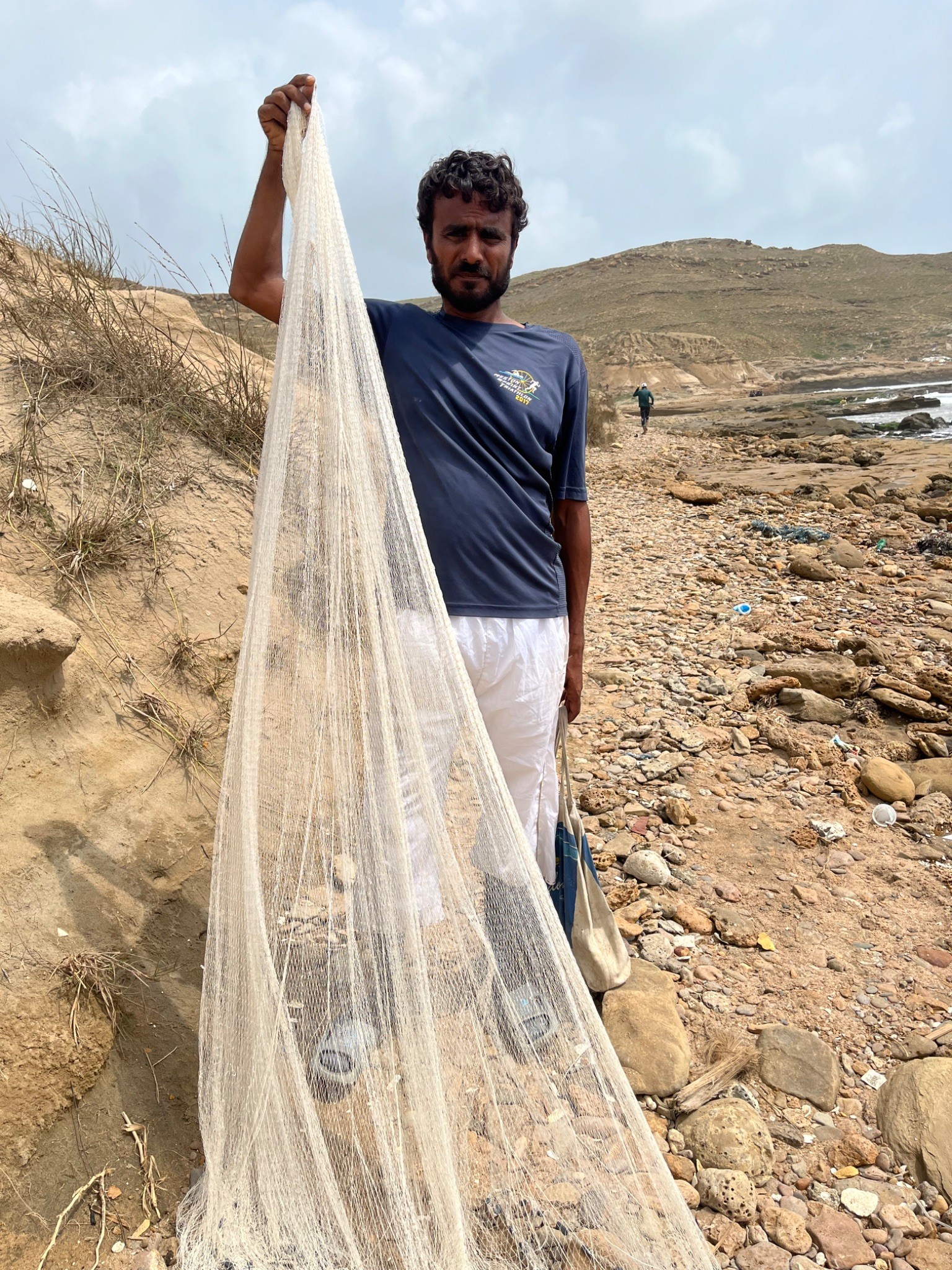
Gill nets used by fishermen to catch fish, which are left abandoned at sea leading to green turtles getting stuck in them – Hawwa Fazal
“The turtles who come to nest on the beach are often tangled up in the discarded nets on the beach. It is painful to see them struggling,” said Asma, a 15 year old who accompanies her older brother who is a trained WWF crew member.
As she walks the beach — the sand hardened now by years of construction — she shrugs and bends down to pick up yet another plastic bottle, left behind by a weekend visitor.
“Popular beaches are littered with garbage, dominated by single-use and microplastics,” says Moazzam Khan, technical adviser at WWF-Pakistan.
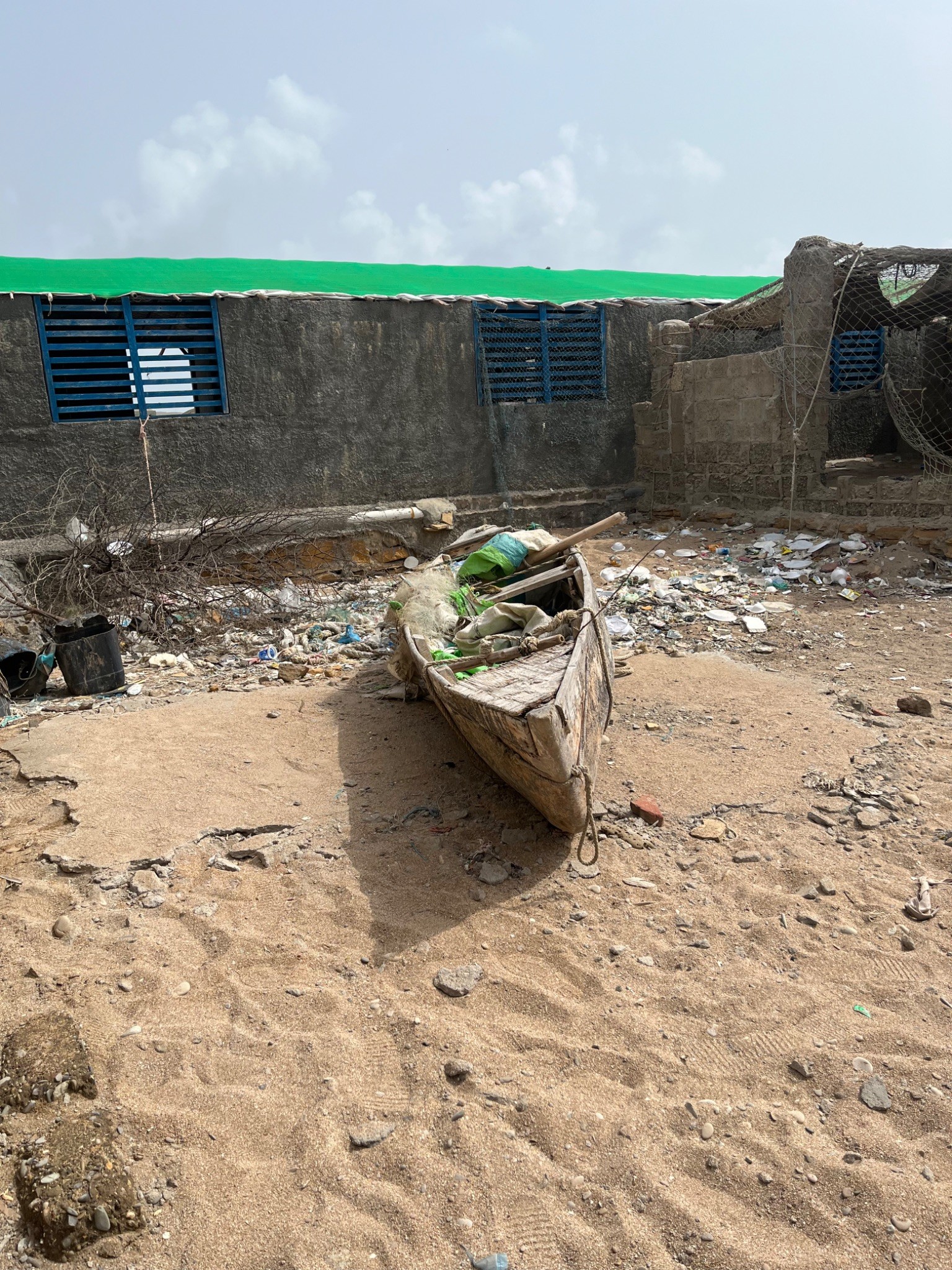
An abandoned boat and plastic trash on Mubarak village beach – Hawwa Fazal
It is this same plastic that ends up killing the turtles Asma and the WWF crew watch over: a floating bag looks, to a hungry turtle, exactly like a jellyfish. Mistaking plastic for food can be deadly..
Deeper water, bigger ships
While the risks from plastic aren’t new, Pakistan’s offshore environment is also being reshaped in unprecedented ways. Global trade has spent two years rearranging itself and Pakistan expects to benefit.
Over the past two years, global trade has shifted away from open globalization toward friendshoring (trading with political allies) and supply chain resilience, driven by US-China decoupling, Middle East shipping risks, and an AI-fueled tech boom.
“Because Pakistan sits at a strategically important location – between eastern and western routes – our ports are becoming attractive for transshipment and increased maritime traffic,” says Dr Shoaib Kiyani, Assistant Zoology Professor at University of Karachi.
He receives me in an office that doubles as an information hub on green turtles — fitting, as most of his work revolves around green turtles.
The trade rearrangement is a genuine opportunity. The catch is the sentence nobody puts in the announcement, “our port infrastructure and coastal ecosystems are not designed to handle sustained high-density marine traffic,” Kiyani noted.
Bigger ships need deeper water. Karachi has two major seaports – Karachi Port Trust and Port Qasim – and deeper water at either of them means dredging navigation channels.
“While this may provide short-term economic gains, it risks causing long-term ecological damage, particularly along Karachi’s coastline,” Kiyani says.
So what does a dredger actually do to a turtle’s sea?
Start with the water.
“The most immediate impact of dredging is the increase in suspended sediments in the water,” Kiyani explains. Stirred-up sediment makes the water cloudy.
Cloudy water blocks sunlight. Less sunlight means less phytoplankton — the microscopic plant life that everything else in the ocean, directly or indirectly, eats.
“Turtles are part of this system,” he explained.
“They depend on marine vegetation like seaweeds, which require sunlight to grow. So even if turtles are not directly impacted at first, their food sources and ecological balance are disturbed.”
Notice what that kind of damage looks like: nothing. No dead turtle on a beach, no photograph, no press statement. Just a food base thinning quietly somewhere below the surface, over years, as the turtles begin to migrate elsewhere. It is the ideal harm because it never shows up in time to stop anything.
How a turtle picks a beach
Then there is the sand: not a neutral feature of the coastline, but a critical resource for turtles.
To see why sediment matters this much, it helps to watch a green turtle try to nest, because she is far pickier than any of us would guess.
In the half-light before dawn on a Karachi beach, the green turtle’s shell shifts between olive, amber and deep chestnut brown, each scute traced in a darker line like tree rings.
Named not for her shell but for the pale green fat beneath her skin, she moves with a quiet, ancient grace, sand clinging to her back as she hauls ashore to nest under the moonlight.
It takes her up to two hours. She comes out of the water after dark, crawls up the beach and starts testing the sand. She digs with her hind flippers, inspects the hole, rejects it, moves, digs again.
Only when she approves of it does she deposit an average of 110 eggs, roughly the size of golf balls, into a ditch about three feet deep. Then she does the entire covering-up in reverse and drags herself back to the sea, exhausted. She will do this 10 to 15 times in her whole life.
Every stage of that is a demand on the sand. For turtles, the process requires not just sand in general, but sand at a specific beach, with a certain composition, moisture and temperature.
The temperature does something remarkable – if the sand during incubation is above 27 degrees celsius, the hatchlings will be female. If not, male.
Hence everything needs to be just perfect.
If it’s too hard she will not dig. If there is too much rubble, loud sound and bright lights, she will abandon the whole attempt and go back into the water with her eggs unlaid.
According to Ashfaq Ali Memon, the head of marine wildlife at the Sindh Wildlife Department, who has been looking after the hatchlings and this breeding process, “This is not random: the turtle which is coming in November had possibly been born at the same time decades ago.” Turtles return to lay eggs on the beaches where they were born, at the same time when they themselves once hatched.
However, what she does not know is that her birthplace — Sandspit beach in Karachi, where her mother laid her eggs a few decades ago — has been developed so heavily that there isn’t enough space, sand, moisture or darkness left for her to lay her own. The beach itself hasn’t vanished; its balance has and that balance is everything.
Beaches are never still. They are a running account where sediment arrives, sediment leaves and the balance is what you stand on.
When humans get involved they move sediment when they do dredging. They remove sand when reclaiming land. They harden the beach when they do coastal construction.
With these actions, sand on the beach changes. It thins, and it compacts, which changes how deep she can dig, how much moisture the nest holds, how warm the eggs get and whether the beach will be there in fifteen years when her daughters come looking for it.
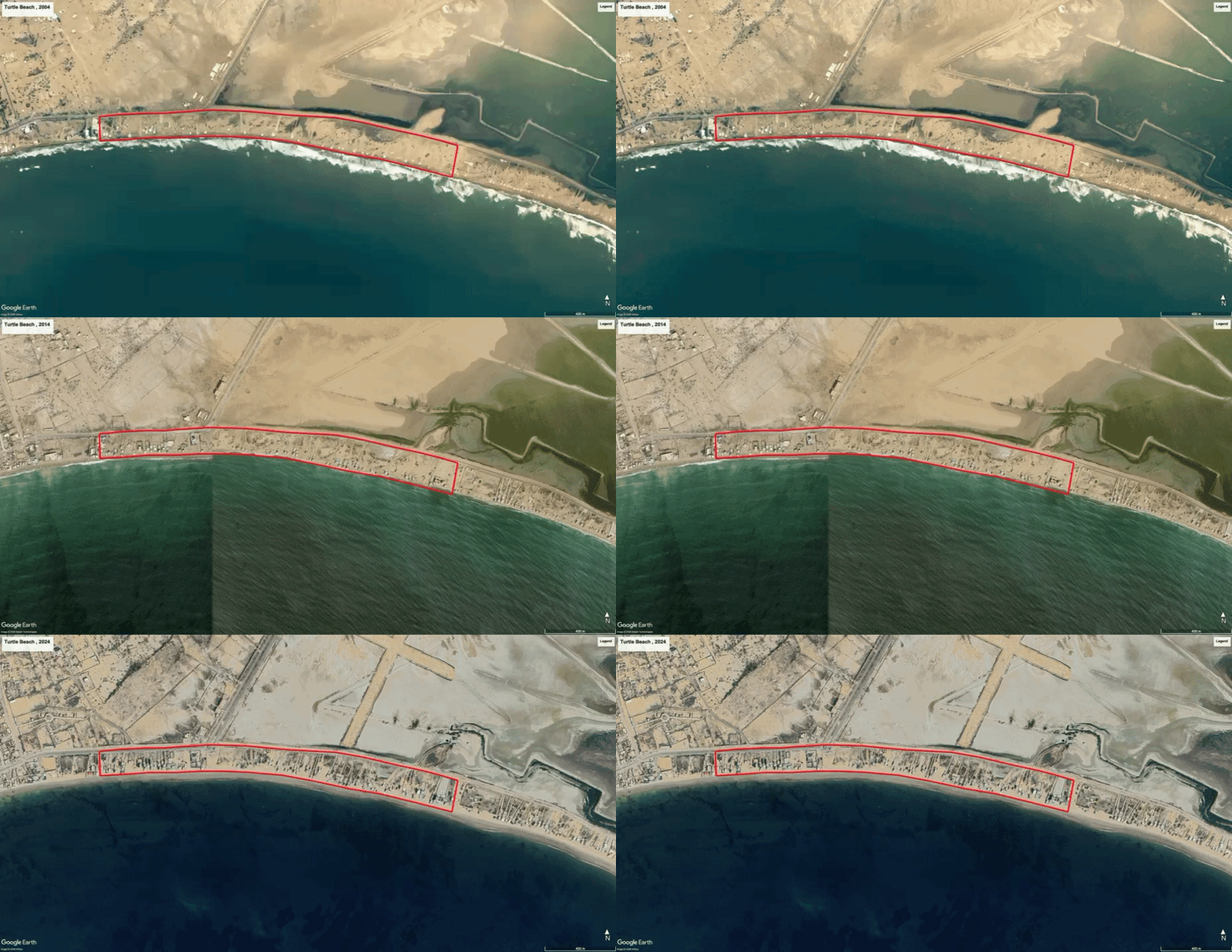
The picture (dated 2004,2014,2024) above shows ‘Turtle Beach’ located in Karachi, Pakistan. It is a vital protected nesting ground for the endangered green sea turtle. The image showcases the rapid development of the coastline which has made it difficult for green turtles to nest here. – GIS Mapping developed by Hawwa Fazal
This coastline is already being rebuilt by hand, and it has been documented. A 2024 Dawn investigation traced how a mangrove lagoon at Hawkesbay was turned into notional real estate through a technique called sand trapping — thin tracks built into the water so sand flushed in at high tide couldn’t get back out — topped up by dumper trucks arriving ten at a time and leaving lighter by sunset.
Yet no one is studying how this may have impacted turtles along the coast.
Plenty of law, but not enough machinery to enforce it
Pakistan is not short of turtle protection on paper.
Under the second schedule of the Sindh Wildlife Protection Ordinance of 1972, every marine turtle in the province is a ‘protected animal’.
Pakistan is a signatory to the Convention on International Trade in Endangered Species of Wild Fauna and Flora (CITES), and there is an environmental protection agency in Pakistan whose entire job is to assess and warn of harm before it happens.
Despite that, there is no long-term, publicly available beach-profile monitoring dataset for Karachi’s nesting beaches. There is no necropsy facility in Balochistan.
Moreover, local environmental assessments aren’t always carried out before projects impact the environment. When Dawn investigated the filling of the Hawkesbay backwaters, it found Sindh Environmental Protection Agency (SEPA) had summoned the builder because the housing scheme had no Environmental Impact Assessment at all.
The SEPA did not respond to repeated requests for comment. The National Institute of Oceanography refused to share Geographic Information System (GIS) data – which could have helped determine the loss that has occurred to space over the years – with one expert calling the question “too political” in a phone call with Dawn.
Amber Alibhai of the NGO Shehri, which has spent years fighting land grabbers in Karachi’s courts, summed up the local relationship between paperwork and truth: “Many times, too much documentation is done to convolute the truth.”
Conservationists have been asking for years to declare the turtle beaches of Sindh and Balochistan marine protected areas.
“This is essentially needed for conservation of marine turtles. These unique and iconic animals have been in existence for more than 100 million years but now face serious threats to their survival,” said Rab Nawaz, senior director conservation biodiversity at WWF-Pakistan. “Human activities such as destruction of nesting sites and unplanned development, as well as climate change are pushing turtles closer to extinction.”
A graph that wobbles
So why hasn’t any of this forced the government to take concrete action?
Because the turtles are still here and the numbers move around enough to argue.
Nesting counts at Hawke’s Bay and Sandspit go up and down year to year without settling into a trend, and that wobble is precisely what makes this so difficult to raise in a policy meeting. It is very hard to legislate against a graph that wobbles.
The hatchling figures were terrific in 2022, when volunteers, responsible for shooing away wild dogs and ensuring a safe path from sea to the nesting side for turtles, successfully hatched 30,000 eggs. In 2023 the count was also high, passing 25,000 barely halfway through the season.
“The Marine Turtle Conservation Unit, managed by the Sindh Wildlife Department has been operational since 1980, [and] to date, has protected and released over 850,000 turtle hatchlings,” said Memon.
850,000 is a genuinely impressive number and it measures how many nights volunteers walked a beach with torches.
However, hatchling releases record effort, not the state of the beach they are working on.
Experts believe Pakistan has lost 25 to 30 percent of the green turtle’s nesting ground over the past decade.
WWF-Pakistan has been blunt that hut construction along beaches in Karachi and Balochistan has adversely affected major nesting grounds and that plastic waste, collapsing huts and rubble now endanger nesting females and juveniles directly. Sandspit’s 8 km stretch has been eaten into by concrete beach houses standing exactly where turtles need to dig.
“Once I saw someone disturbing a turtle while she was laying eggs. She ran off for safety, leaving a trail of eggs behind her. That was a very painful scene,” says Haseen Bano, who supports the volunteers’ work at Sandspit.
The last of them
We have watched this happen before. The olive ridley, Lepidochelys olivacea, was once the commonest nesting turtle on this coast, “sometimes in even greater numbers than green turtles,” said Kiyani.
Its mass synchronised nesting, the arribada – thousands of females coming ashore on the same nights – used to happen here. In the early 2000s, it stopped.
“Alive olive ridleys have not been seen on Karachi’s shores since 2010. Dead ones still wash up – one of them at Gwadar in April,” he added.
The species itself is fine.
“What is important is that they have not disappeared from the ocean – they are still abundant,” Kiyani noted. “Yet, they have abandoned Pakistan’s beaches entirely. This suggests that changes in coastal or marine conditions can permanently disrupt nesting behaviour, even if the species itself survives elsewhere.”
Elsewhere the arribada continues at a scale that is hard to imagine from here — up to 450,000 nests a year at La Escobilla in Mexico and Gahirmatha and Rushikulya just along the coast in Odisha. Pakistan stopped being one of those places without any warning.
“The arribada is not only a spectacle of nature’s coordination but also a reminder of how delicately balanced marine ecosystems are,” said Moazzam Khan.
Which leaves the green turtle and volunteers paid according to how donations are going that year, who walk Sandspit and Hawke’s Bay after dark through the season.
Of the five species recorded on Pakistan’s beaches, hawksbills and leatherbacks are very rare. Loggerheads, olive ridleys and green sea turtles were spotted more often. Loggerheads, in the past few decades, have stopped coming to Pakistan’s shore. They are in the sea around but they don’t come to the shore to nest.
Green turtles are the only ones being spotted regularly now.
“When the turtles arrive to use the pits, our volunteers are present to take care of them and to ensure no one can disturb them,” Amir Khan told AFP.
Mohammad Javed, 29, took the job over from his father. “It feels good to take care of these turtles, they boost the beauty of our beach,” he said.
As Ashfaq Ali Memon puts it, “Being human doesn’t only call for loving another human being.”
“These animals also require the same attention and love.”
But affection was never the constraint. Kiyani names the situation on Pakistan’s beaches “a form of coastal exploitation, where short-term gains come at the cost of long-term ecological stability.”
“Once turtles abandon a nesting site, as we’ve already seen with olive ridleys, it is extremely difficult to reverse that loss,” he said.
Taken alone, none of this looks fatal to the green turtles. An oil slick that dissipates. A ship that eventually sails off, its hull scrubbed. A dredging permit that was approved because the water cleared in a few weeks. Each threat is small or slow enough to survive scrutiny on its own.
Together, they close in on her from every direction. A war fouling the coast she swims through with crude oil. Gillnets and ghost nets that strangle her. The plastic she mistakes for food, which poisons her from the inside. A dredging boom starving the seagrass she feeds on. Beaches hardened, built over and mined for sand until there’s no sand left for her to dig. And underneath it all, laws that exist on paper and almost no one enforcing them on her behalf.
No single threat may be enough to make her disappear. That is precisely what makes the danger so easy to miss.
Pakistan has been here before.
The olive ridley is still out there — still abundant elsewhere — but she has not nested on Pakistan’s coast in more than 20 years.
There was no single moment when she vanished. No final alarm that forced anyone to choose between development and her survival. By the time anyone was certain, she had gone, there was nothing left to decide.
The green turtle is what remains to lose.
Unlike the olive ridley, she does not have a second coast in her: she nests only where she was born. Every deeper channel, every reclaimed lagoon, every wall along the sand is approved on the quiet assumption that she will keep coming anyway.
She will.
Right up until the year she doesn’t.
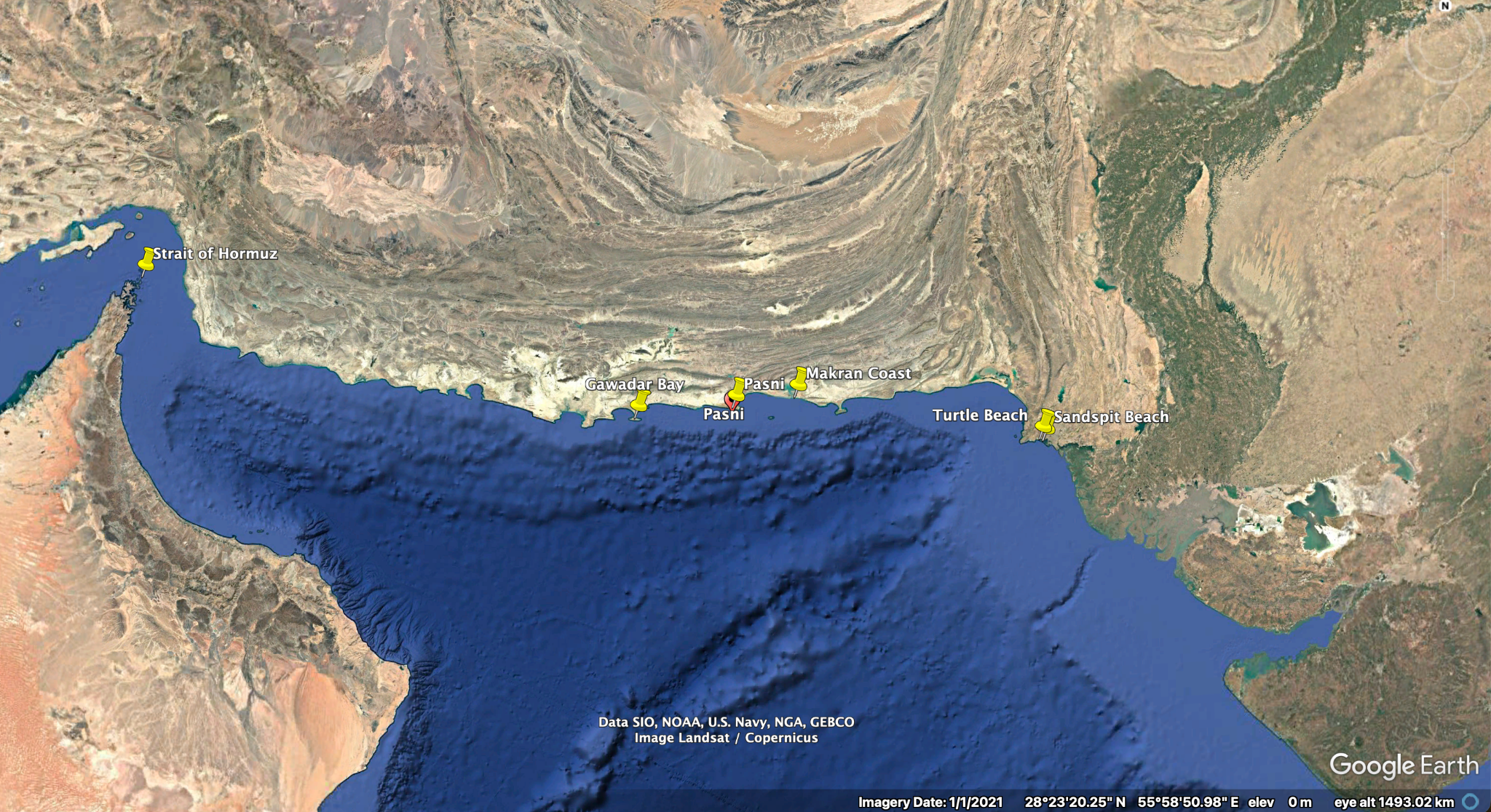
Understanding Key locations mentioned in the story – GIS Mapping developed by Hawwa Fazal